
THE BEES ARE BACK... WHICH MEANS ANYTHING COULD HAPPEN.
©MerietDuncan
FEBRUARY/March in the Apiary (and Beyond)
Because the honeybees themselves have been rather quiet, I’ve decided to combine a couple of my activities in February and the beginning of March into one blog post. You might think February would be a sleepy month in the beekeeping world — and for the bees it largely is — but for the beekeeper it can be surprisingly busy if you’re preparing properly for spring.
And busy it has been.
A Talk in Maidenhead
February began with a talk for the Maidenhead U3A. Around eighty people were expected… boom! The more the merrier, as far as I’m concerned. Someone once asked me what the maximum number of people I would speak to might be. My answer?
“Hello Wembley!”
I’d never been to Maidenhead before, and the journey there was… let’s just say “memorable.” Torrential rain accompanied me most of the way, and the endless roundabouts and one-way systems kept my nerves permanently on edge.
Now normally I love driving. I enjoy the solitude of the car, listening to a podcast or a good radio programme. But this journey was not one of those relaxing drives.
Eventually I arrived at the venue — a huge Methodist church that seemed to start in one street and finish in another. Determined to find somewhere to park, I followed the building around the corner.
And within a nanosecond…
I was in an “All Motor Vehicles Prohibited” zone.
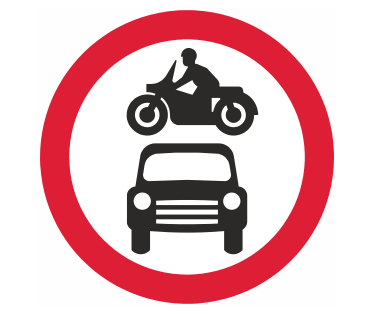
I hadn’t seen the sign because I was concentrating on the road and the building rather than looking up. By the time you realise these things you’re already doomed because you have to find somewhere to turn around.
Fortunately, there was only one person in the entire street — a man sitting on a bench eating a sandwich — who looked at me with the unmistakable expression of someone thinking, “Yes… you’ve been clocked.”
The road was only about 200 metres long, so I quickly turned around, praying there wasn’t a camera.
Of course there was.
Five days later the dreaded letter arrived with the humiliating photograph of my car entering the zone and a fine attached. My client kindly reassured me that I probably wouldn’t hear anything.
Reader… I did.
Fight it? No point. I sighed and paid up.
Dang it.
Fortunately, the talk itself went wonderfully well. Lots of questions at the end — always a good sign — and one woman came up afterwards and said:
“That’s the first talk I haven’t fallen asleep in for ages!”
Well… I’ll take that as a glowing testimonial.
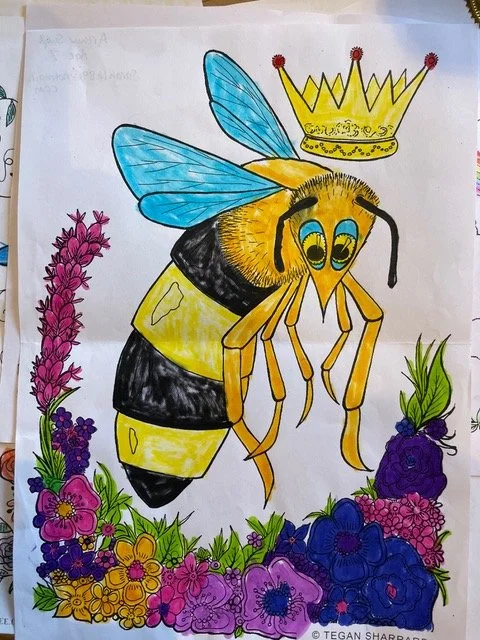
ARTHUR SWIFT - AGE 7 - COMPETITION WINNER
The Telford Beekeeping Show
The following week it was off to the Telford Beekeeping Show. I’ve already put my name down for a stand at the 2027 show -https://www.thebeekeepingshow.co.uk/ - I should be giving a talk about my trip to Africa as research for my final book in the Betsie Valentine series… “The Honeybees of Hope.” Make a note in your diary - it’s a grand day out!
I drove up the day before, set up my stand, then continued on to Hereford to stay with my sister. The show itself was just one day, but it was a fantastic one.
So many visitors stopped by my stand. Lots of books were sold, plenty of email addresses collected from people wanting to know when the new book comes out, and even a few bookings for future talks.
The colouring stand was very popular, as always, and I’ve just had the lovely job of telling the competition winner they’ve won.
After the show it was back to my sister’s house for the night — she lives an hour away from the venue while I’m two and a half hours away — and then home the next morning.
Exhausted, but happy.
World Book Day (A Slight Disappointment)
World Book Day came and went this year without a school visit for me. I won’t pretend I wasn’t a little disappointed — it’s the first time I haven’t been in a school on World Book Day. Normally I’m surrounded by excited children, heroic teachers dressed as literary characters, and at least one pupil asking a question about bees so brilliantly unexpected that I have to pause for a moment and think.
This year? Just me. No costumes. No buzzing classrooms. Not even a slightly wonky Very Hungry Caterpillar wandering past. (If you’ve been in a primary school on World Book Day, you’ll know exactly what I mean.)
But I am new to this area, so I’m choosing to believe this was simply a warm-up year. A quiet rehearsal before the real show. Fingers crossed for next year.
And if any teachers are reading this, do make a note and book me (https://mdthequeenbee.co.uk/contact) for World Book Day next year. I bring stories, honeybee secrets, and the sort of bee facts that make children gasp and teachers quietly say, “I did not know that.”
You won’t regret it. The bees certainly won’t!
Cleaning Frames… the Hard Way (Then the Easy Way)
Now to the bees.
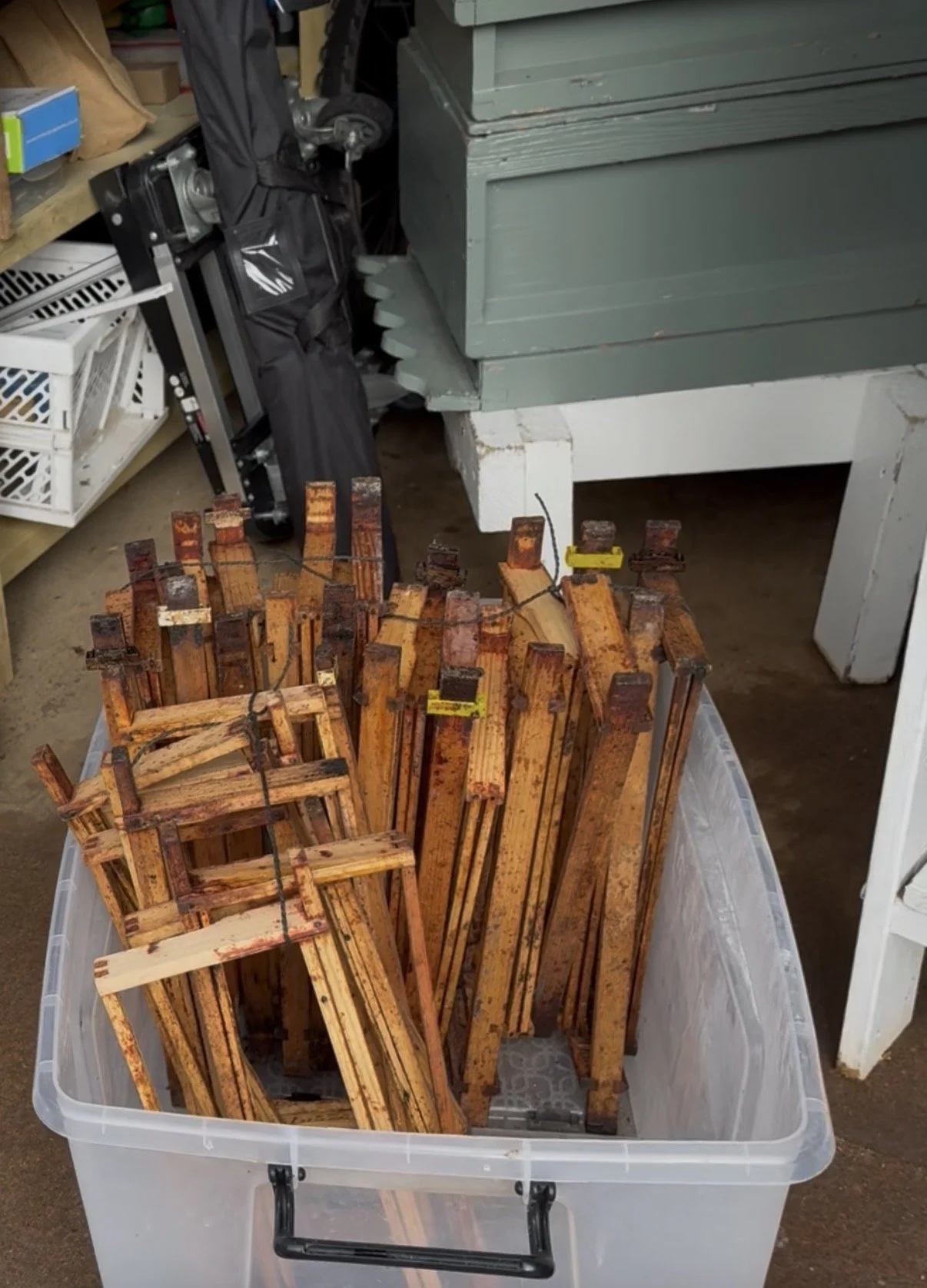
For the first time in all my years of beekeeping, I helped clean old brood frames. Normally my husband steams the wax off and then scrapes the frames while they’re still warm — a messy, unpleasant job he dreads and usually postpones until the last possible moment.
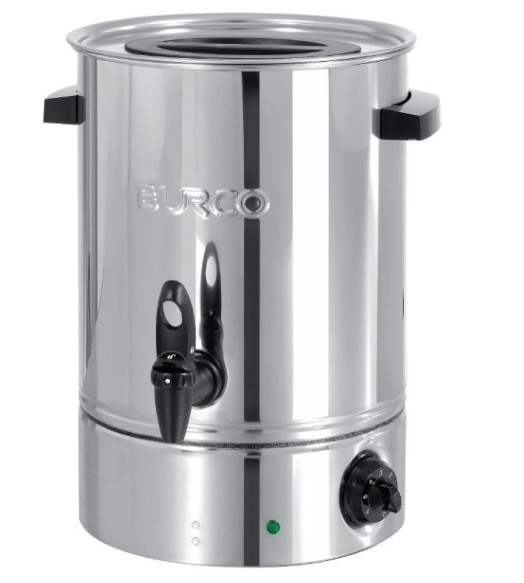
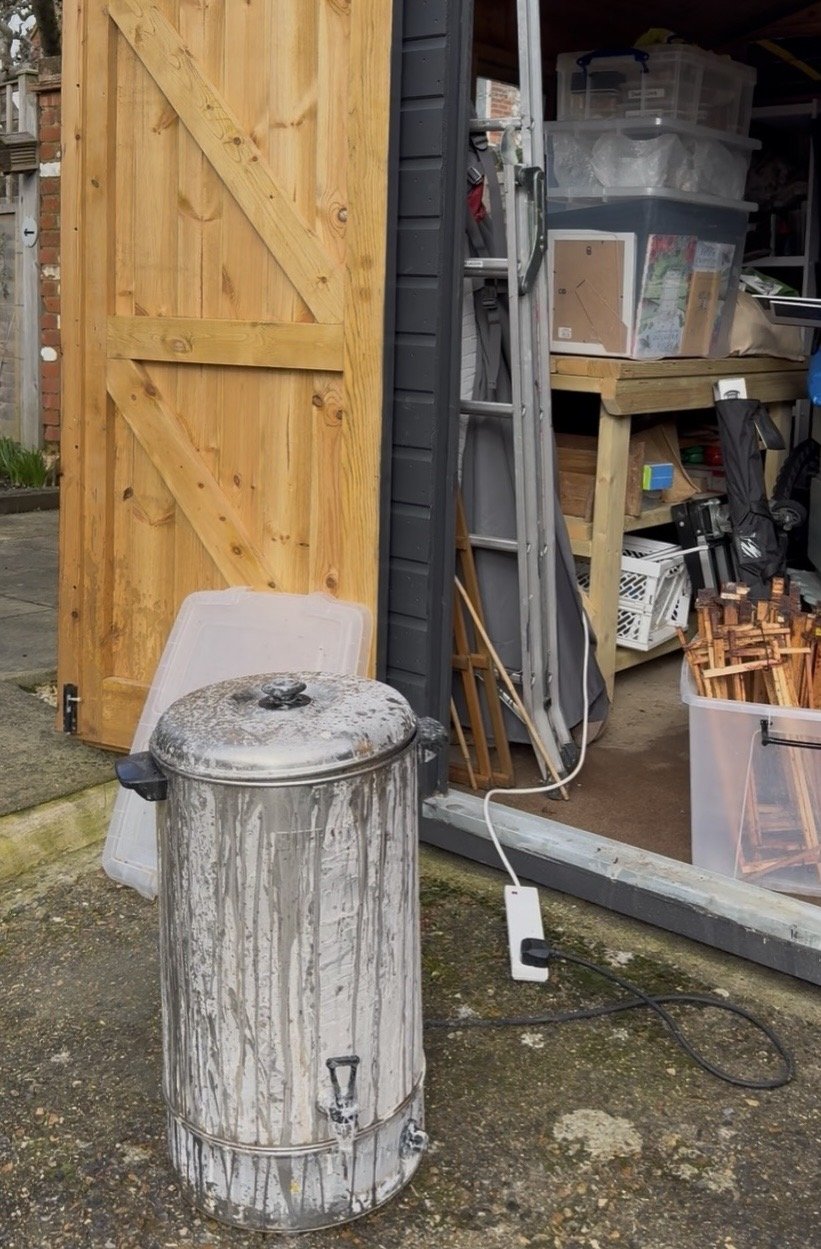
But this year we had help from something called a Birko Boiler.
Everyone nodding knowingly?
Yes… a Birko Boiler.
Where have I been for the past fifteen years?
Apparently the method is simple:
Steam the wax off the frames.
Place bundles of frames (about six at a time) into the Birko Boiler.
Leave for two minutes.
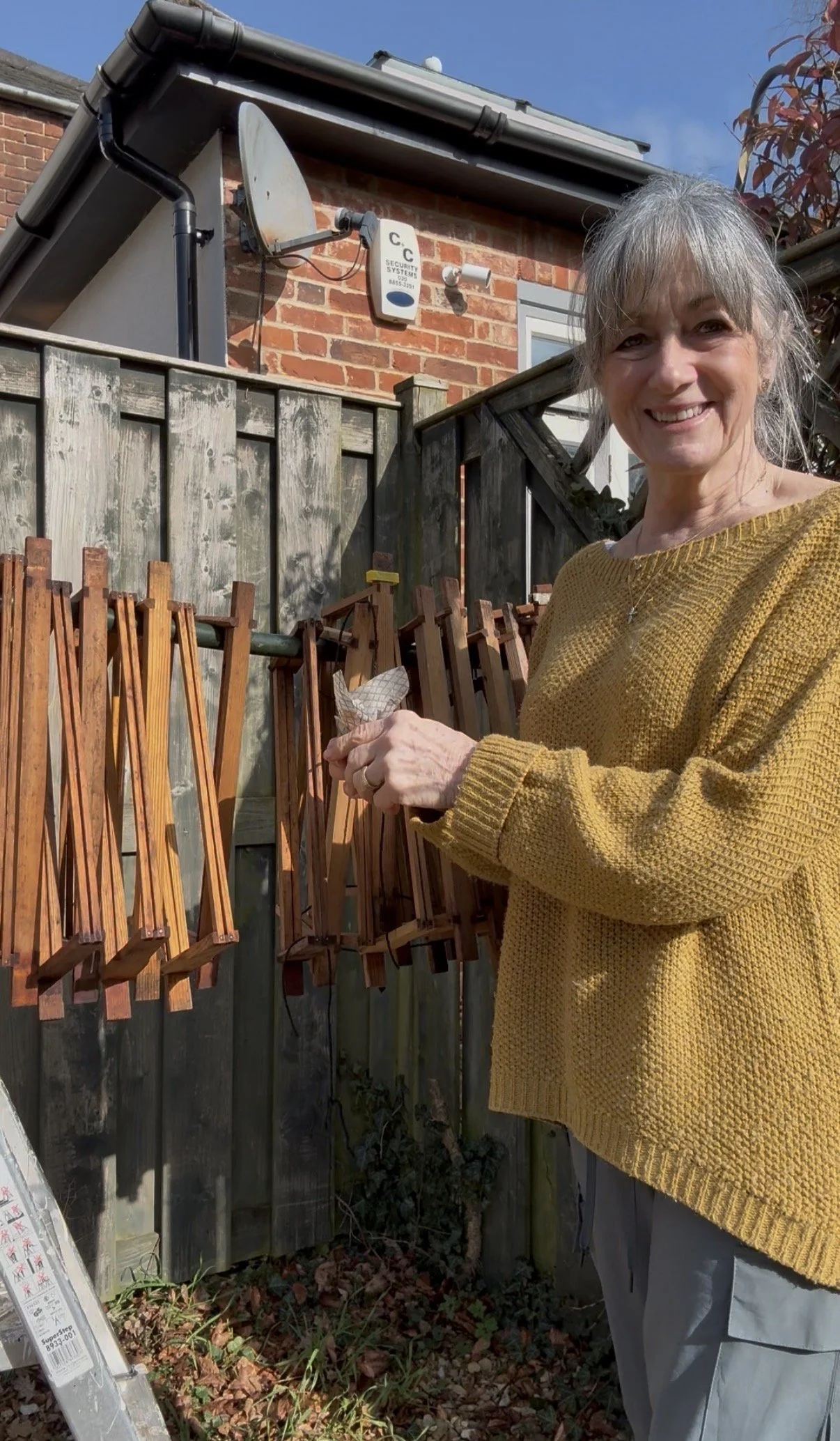
Hang them out to dry.
Frames come out clean and practically like new.
Life-changing.
Of course, it didn’t quite go that smoothly.
First, the boiler took four hours to warm up. No matter — plenty of other things to do while waiting.
Then my husband decided to steam the wax off the frames on the driveway while the Birko Boiler sat in the garage.
What nobody mentioned was that adding washing soda makes the thing bubble over.
Water everywhere.
Before we could continue our “seamless” operation we had to empty half the shed onto the drive and mop up what felt like gallons of water.
Now, my husband is a very intelligent man… but surely somewhere in that intelligent brain he might have anticipated a scientific reaction when adding the soda crystals?
Maybe.
Maybe not.
After half an hour of clearing up, the Birko Boiler was moved safely outside the shed. Lesson learned.
Next year we will glide through the whole process like professionals and the frames will be clean within minutes.
Back of the net.
A Rare Glimpse of the Sun
Those of you in the UK will remember that the sun dared to appear for a couple of days recently. A slightly suspicious golden object appeared in the sky and the entire country reacted as if we’d never seen such a thing before.

Dawn French posted a funny video on Instagram of herself screaming and shielding her eyes from this mysterious bright intruder in the sky. Completely understandable behaviour, we’re simply not trained for that level of brightness. Frankly, if it happens again, I suggest we all remain calm, put the kettle on, and wait for the clouds to return to restore the natural order of things!
Although having said that, the bees were absolutely delighted. Which, if I’m honest, is really the only opinion that matters.
Of course I grabbed the opportunity to visit the apiary.
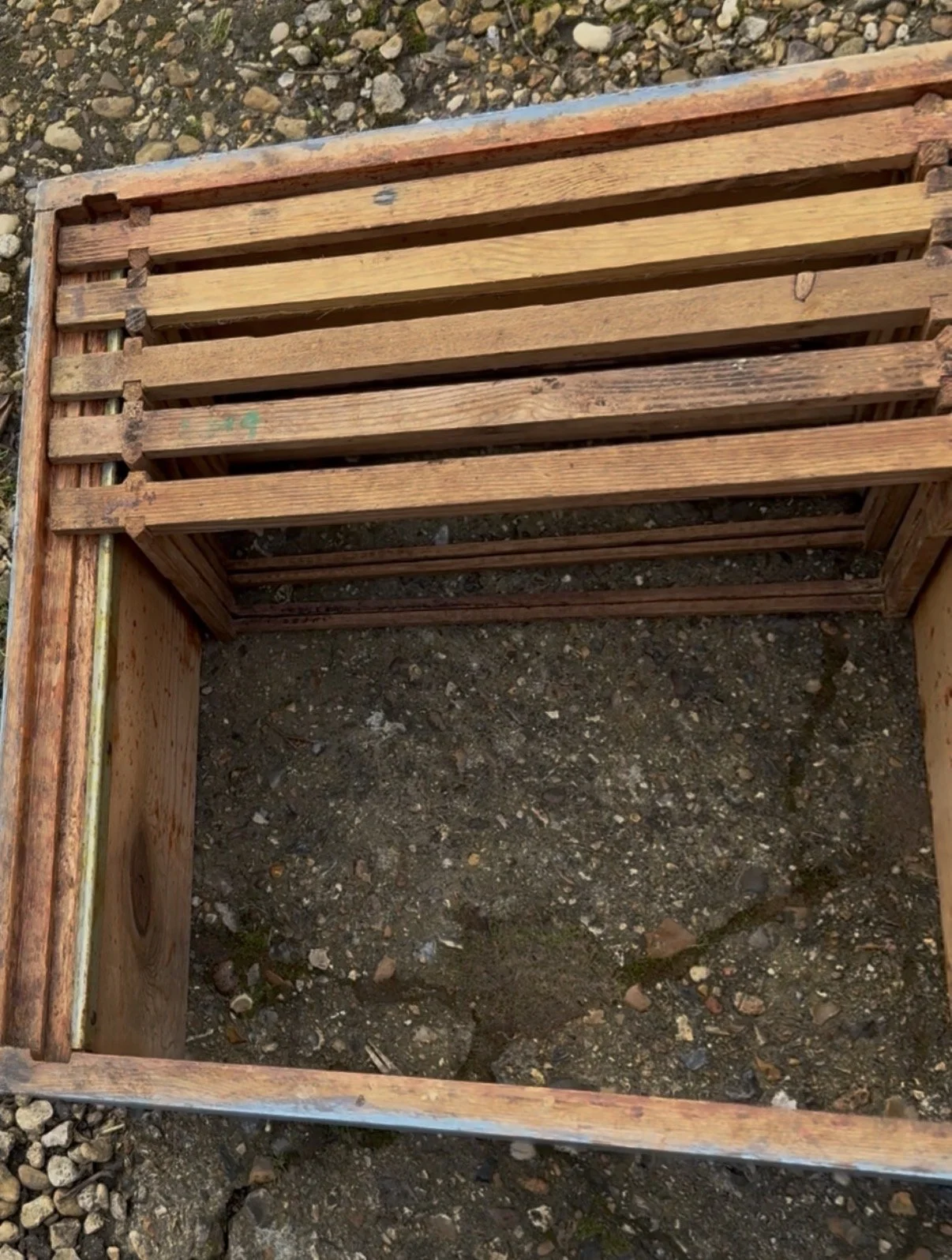
I removed the supers from underneath two of the hives — the third didn’t have one. This is the first time I’ve ever left supers on after the summer honey harvest. I usually remove them when the blackberries begin to show in August and allow the bees to build their winter stores from Himalayan balsam and ivy.
If the hives feel light in late September, I feed them.
These days I feed fondant only, not sugar syrup. That’s advice I took from the excellent blog The Apiarist - https://theapiarist.org/ - written by David Evans. His writing focuses on the “science, art and practice of sustainable beekeeping” — well worth reading if you’ve never come across it.
My personal theory is simple: If fondant is good enough for David Evans’ bees, it’s good enough for mine. And it’s far less faff — especially since my bees are not in my garden.
If you’d like to see the super removal in action, here’s the little video I filmed that day (I forgot my tripod, so forgive the camera work):
https://www.youtube.com/watch?v=A_OPI7-V2Og&t=22s
A Second Sunny Day
The next sunny day, like the bees I made the most of it and returned to the apiary to remove some excess stores from the brood boxes and replace them with fresh foundation so the queen has space to lay.
Was it too much intervention this early in the season?
I’m not entirely sure yet.
Time will tell when the warmer weather arrives and I carry out my first proper inspections. Fingers crossed I haven’t upset their equilibrium.
You can watch that visit here:
https://www.youtube.com/watch?v=aaZ-1sCxBic
Ready… or As Ready As You Can Be
With the frames cleaned and the bees (hopefully) settled for now, I’ve organised my share of the shed.
Supers are stacked and ready for the spring flow, and a couple of brood boxes are waiting in the wings just in case the colonies decide that swarming is the plan this year. (They rarely consult me first.)
I like to think I’m ready for the season.
But of course… these are bees.
And although we keep them in boxes, they are still wild creatures and will always do their own thing. It’s why keeping notes is so important — so you can look back at what happened during your previous visit and attempt to make sense of it all.
Even then, you sometimes find yourself standing there, veil on, smoker in hand, quietly shaking your head and thinking: “Bloody bees.” (Pardon my language.)
By the end of autumn I’m always relieved to see the back of them… and then I miss them terribly all winter until March arrives again.
Beekeeping, it turns out, is a bit like that friend who drives you completely mad — but you’d be lost without them.
Looking Ahead
That’s it for now. My next blog will combine March and April, when hopefully there will be far more bee activity to report.
This is also the first full year at my new apiary site, so it will be interesting to see how it develops. If the forage proves plentiful and the European hornets behave themselves (last year was not fun), it could be a wonderful place for the bees.
And for me too. Remember the golf buggy?
Yes… that.
If everything goes well you’ll hear all about it here. Assuming, of course, that I manage to steer it safely past the rather large pond on the way to the apiary and don’t end up explaining to the bees why their beekeeper has arrived with a confused duck on her head… yes there is a duck house in the pond.
So keep checking in each month to see how the season unfolds.
Thank you, as always, for following along.
And I’ll leave you with this lovely thought and photograph, which feels particularly fitting in troubled times:
“Where there are bees there are flowers, and wherever there are flowers there is new life and hope.”
— Christy Lefteri
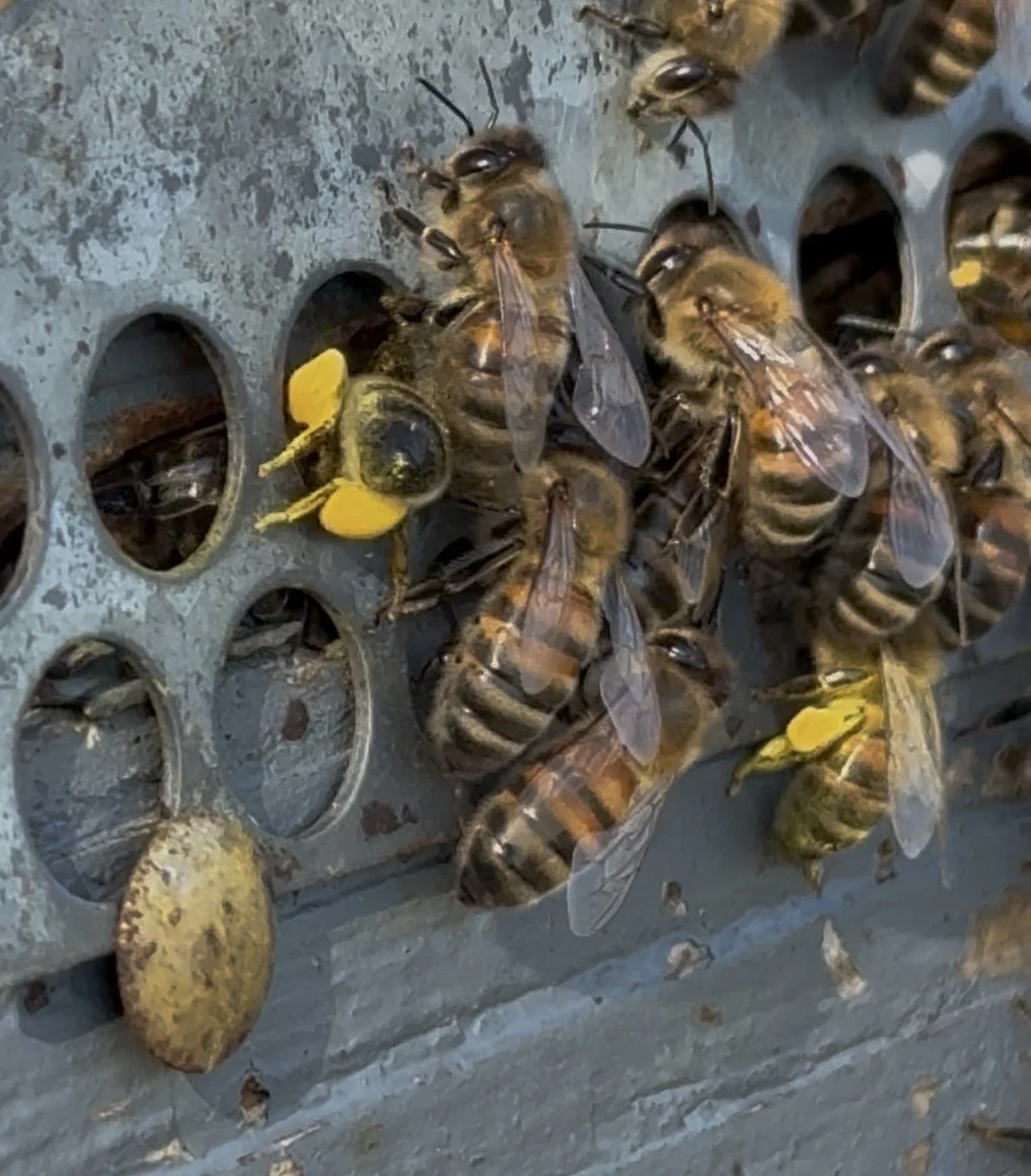
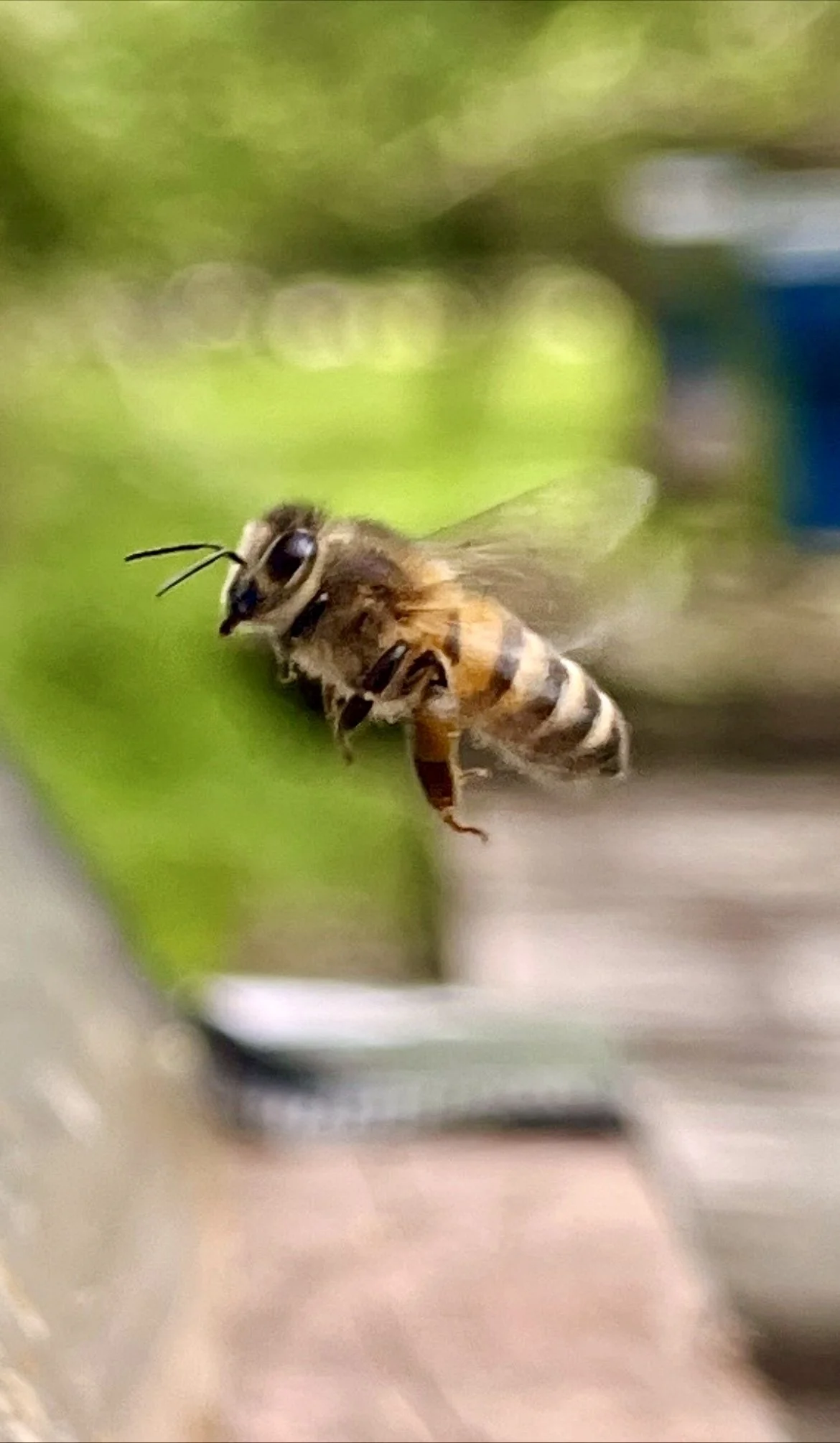
I took this photograph at the hive entrance. The bees bringing in the first pollen of the year — bright golden pollen baskets carried carefully on their legs after the long quiet of winter. For a beekeeper, it is one of the most reassuring sights of spring. A reminder that the season is turning and that life, patiently and steadily, begins again. (©MERIETDUNCAN)